Why AI results vary, and how to get a steadier answer
Why two scans can differ, and why two agreeing scans mean more than one confident one.
Marcel Buth · Co-founder, IsItGOLD?
· 2 min read
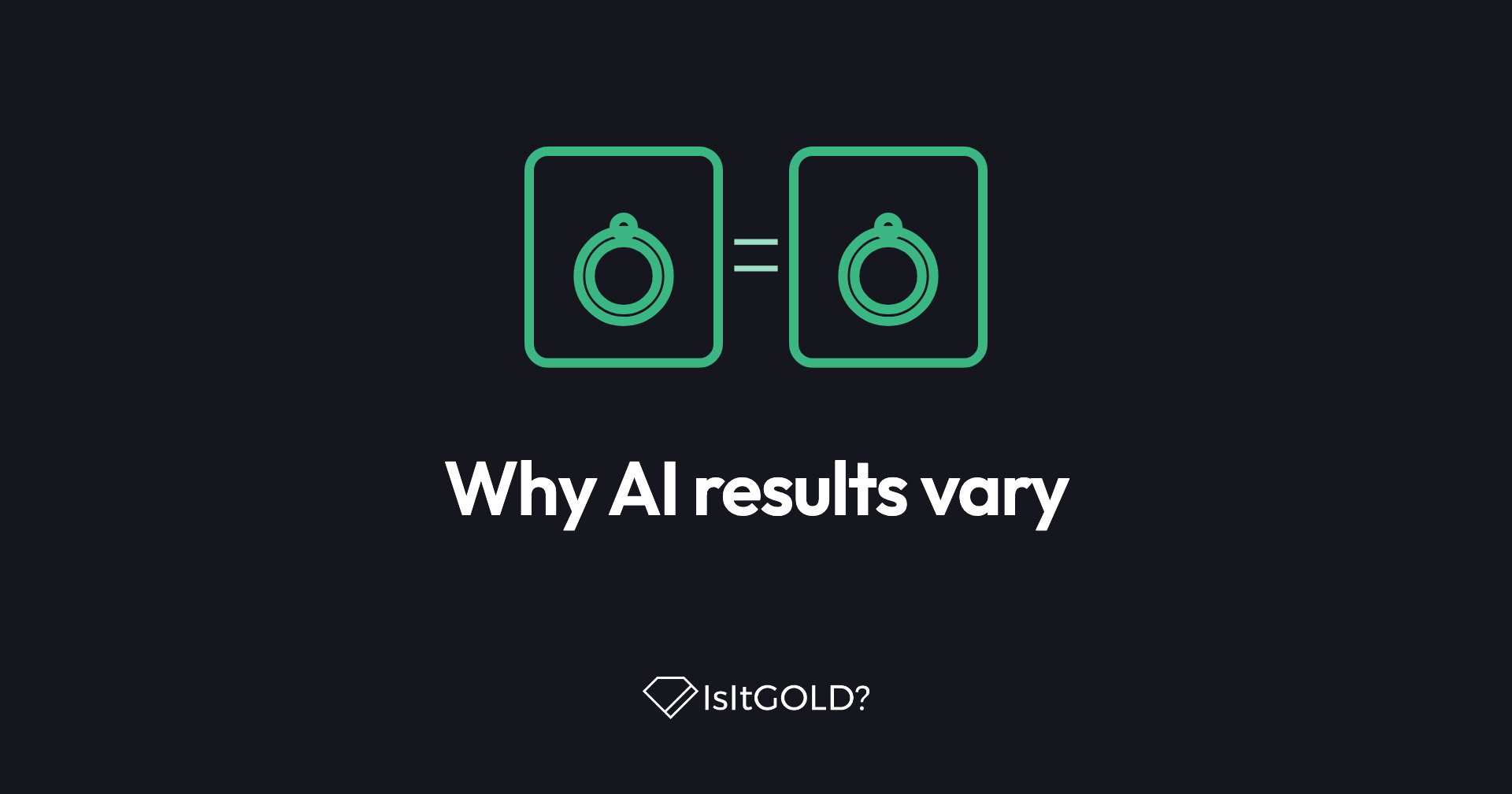
Ask the same question twice and an AI system may phrase the answer differently. That is normal, and it is worth understanding rather than being surprised by, because it changes how you should read a single result.
Results can vary, and that is information
Small changes in lighting, angle or wording can shift an analysis. If a result looks off or reads as unusually uncertain, that is not a dead end — it is a signal that the evidence in the photo was thin.
What to do about it:
Re-scan with better inputs. Not the same photo again. Move to a window, change the angle, get closer to the stamp, put the piece on a plain background. Small improvements to the photo produce noticeably steadier results.
Simplify what you typed. Long, speculative descriptions are less useful than short factual ones. "Marked 585, reddish tone, 4.2 g on a scale" gives more to work with than a paragraph of theory about where it might have come from.
Leave the unknowns unknown. Stating a purity you are not sure of does not help. If the photo and your description disagree, the analysis has to reconcile them, and it will tell you it is uncertain.
Two consistent results beat one confident one
If a piece matters to you, scan it twice, with genuinely different photos — a different angle, better light, the stamp filled in the frame.
Two independent scans agreeing is meaningful evidence. One scan agreeing with itself is not. And if two careful scans disagree, that is the clearest possible signal that the object needs a physical test rather than another photo.
A note on technical terms
Some vocabulary in this field — karat, hallmark, plating, assay — has no clean equivalent in every language. If you are describing something and the precise word is not coming, writing the technical term in English alongside your own description costs nothing and removes ambiguity.
The app itself is fully localised in eight languages, and you should use it in whichever one you think in.
What this adds up to
- Use good photos before you use more photos
- Keep descriptions short and factual
- Scan twice for anything that matters
- Treat a steady estimate as a reason to get an independent test, not as a result in itself
An estimate is an estimate. Knowing how much weight to put on one is most of using the app well.